A pair of bookshelf speakers can look simple on a quotation.
But the same cabinet size can represent very different products: an active desktop system, a television speaker, a turntable solution or a passive pair that still needs an amplifier.
Two products may look similar in catalogue images while asking the buyer to make completely different decisions about amplification, source inputs, power, accessories, packaging and retail explanation.
Before comparing price, the buyer and manufacturer need to make sure they are evaluating the same complete system.
That begins with the product’s intended role. It continues through sound direction, physical sample review, source and power details, packaging and the evidence behind every important claim.
The objective is not to create a longer specification sheet. It is to make the quotation, sample and commercial decision refer to the same product.
Start With the Complete System, Not the Cabinet
The first distinction is whether the bookshelf speakers are active or passive.
An active system includes amplification within the product. It may also include source inputs, wireless connectivity, controls and a power supply. The buyer is therefore evaluating a complete operating system, not only two speaker cabinets.
A passive pair requires an external amplifier and related cables. The speakers may appear simpler, but the final user setup contains more separate components and compatibility decisions.
Neither architecture is automatically better. The relevant question is which system the intended channel is prepared to sell, explain and support.
The product role then gives that architecture context. A compact active pair intended for a computer desk may need different inputs, controls and physical proportions from a system designed for television audio or a turntable setup. A passive pair intended for an existing hi-fi channel enters a different source and amplification environment again.
This role should be stated before the manufacturer recommends a platform or builds a sample. The brief should identify the intended user, placement, source devices, sales channel and position within the buyer’s range.
For an active system, the buyer also needs to understand where the amplifier and controls are located, how the left and right speakers connect, which accessories complete the system and what the product listing must explain. For a passive system, the relevant electrical requirements, terminals and amplifier context need appropriate technical evidence.
The cabinet is only the visible starting point. The complete system is the product being sourced.
Define the Sound and Use Context
Requests such as “good bass,” “Hi-Fi sound” or “premium tuning” are too broad to guide sample development or approval.
A manufacturer needs a usable listening context. That includes the expected listening distance, typical source and content, intended volume range and the tonal direction the buyer wants the sample to demonstrate.
For example, a near-field desktop product may be reviewed differently from a speaker intended for general listening across a living space. A product used mainly for spoken content, mixed media or music may place different emphasis on vocal clarity, tonal balance or low-frequency weight.
The brief does not need to prescribe the acoustic design. It should give the supplier enough direction to understand what the product is meant to do and what the buyer will listen for.
Useful inputs may include reference products, listening notes and observations about how the sound should behave as volume changes. If low-frequency weight is important, the team should also define how it should relate to midrange clarity and the intended listening level rather than asking for “more bass” in isolation.
Driver size, amplifier rating and cabinet material are design inputs. They do not prove the final sound. Performance judgments should be made on the relevant sample, under documented listening conditions, against an agreed product role.
That distinction matters during quotation. Two products with similar specifications may produce different results, while two products with different component choices may still be designed for the same commercial role.
Inspect the Physical Sample, Not Only the Specifications
The sample brings the product architecture and the physical execution together.
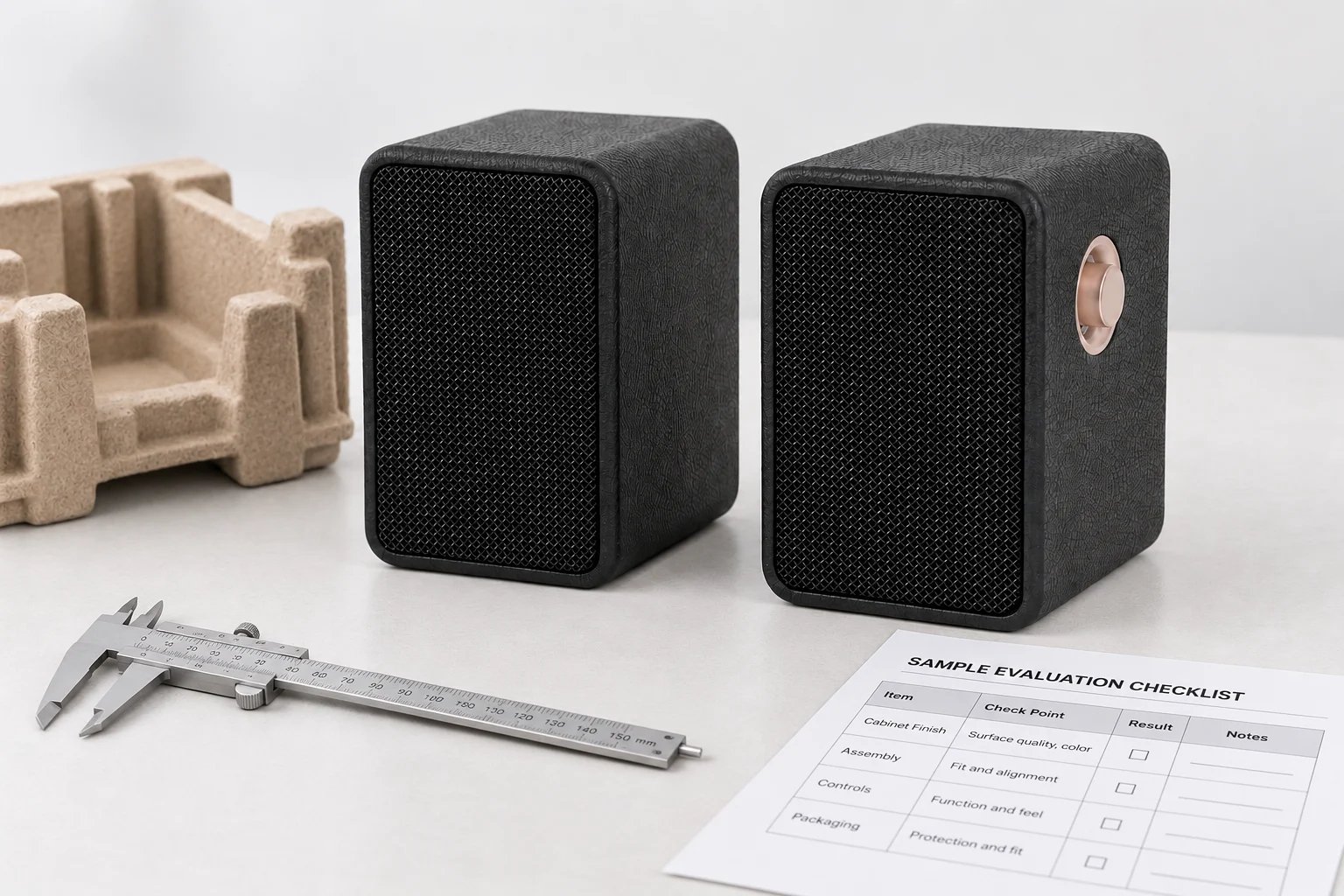
Bookshelf-speaker review should include cabinet joints, surface finish, grille alignment, driver mounting, controls, connectors and the fit of visible parts. The pair should also be checked for consistency between the left and right units.
Mechanical observations deserve the same discipline as listening observations. A rattle, vibration, buzz or loose part should be recorded with the conditions in which it appears: source, content, volume, supporting surface, affected unit and whether the issue can be repeated.
That information helps separate possible acoustic-tuning questions from cabinet, assembly or mounting problems. A general comment that the product “sounds wrong” gives the development team little direction.
Physical review should also consider the intended placement. Confirm that the product stands securely on the relevant surface, that cables do not create unnecessary strain and that controls and connectors remain accessible in the expected setup.
A sample can reveal good work as well as problems. Consistent gaps, secure mounting, aligned grilles and stable controls help show whether the physical execution supports the intended product position.
The purpose of sample review is not to search for a perfect-looking prototype. It is to understand what the current version proves, which issues remain open and what must change before the next decision.
Verify Source, Power and Version Details
Connectivity should follow the intended source devices, not a generic desire to include more inputs.
A computer, television, turntable or general analogue source may require different connectors and operating behavior. Depending on the platform, possible paths may include Bluetooth, AUX, USB audio, RCA, optical or other inputs.
The presence of a connector does not by itself prove compatibility with every device. For each required source, confirm the connector type, switching method, volume-control relationship, included cable and expected behavior when the product powers on or when more than one source is connected.
The power solution is also part of the product offer. The adapter, cable, output connector, destination plug and required markings should match the intended market and the approved packaging contents.
If the adapter uses interchangeable plug heads, verify which heads are included and how they lock into place. An adapter body shown without its approved plug configuration is not a complete power solution.
Version control connects these details to the quotation. Record the sample date or revision, current specification, finish, accessories and firmware version where relevant. Unresolved issues and expected changes should remain visible.
A sample does not need to be final to be useful. But the buyer and manufacturer must know whether they are discussing the same version when reviewing price, public claims or production approval.
Confirm Evidence, Packaging and Customization Before Quotation
Every product page creates claims, even when the wording appears simple.
Output, wireless behavior, dimensions, weight, inputs, decoding functions, materials, compliance and any durability or environmental rating should be connected to suitable product-level evidence. If evidence is not available, the claim should remain internal, be qualified or wait for verification.
Packaging must then protect the complete system represented by those claims. For a coordinated pair, that includes both speaker surfaces, controls, connectors, the adapter and plug, inter-speaker cable, remote and any other approved accessories.
The final carton also affects warehouse handling, e-commerce fees and container planning. These calculations should use the approved packaging dimensions and weights rather than an early estimate.
For OEM, ODM or private-label work, the manufacturer should make the customization boundary explicit. Existing product facts, supported platform options and brand or packaging changes should be separated from requests that require new tooling, firmware, acoustic work, compliance review or other engineering activity.
Clear boundaries make the quotation more useful. A broad promise that every request is easy can hide meaningful differences in cost, timing and responsibility.
The quotation should therefore state the product version, included accessories, customization scope, packaging assumption, quantity basis and any facts that still need confirmation. Price becomes comparable only after the buyer understands what each supplier has actually included.
A Concise Pre-Quotation Summary
Before requesting a final quotation, confirm five things:
- Complete system and role: active or passive, intended user, placement, channel and source context.
- Sound direction: listening conditions, expected volume range, tonal priorities and sample references.
- Physical sample status: current revision, assembly observations, left-right consistency and unresolved issues.
- Source and power solution: required inputs, controls, cables, adapter, destination plug and accessories.
- Commercial evidence boundary: public claims, packaging, compliance, customization scope and quotation assumptions.
When these points are aligned, the buyer is no longer comparing cabinet images or isolated specifications. The buyer is comparing complete product offers with clearer responsibilities and evidence.
FAQ
What Is the Difference Between Active and Passive Bookshelf Speakers?
Active speakers include amplification within the system. Passive speakers require an external amplifier. Their source, power, cable and accessory requirements are therefore different.
Should a Buyer Approve Bookshelf Speakers From Specifications Alone?
No. Specifications help define the product, but the relevant sample should also be reviewed for sound direction, assembly, controls, connections, power, accessories and packaging.
Is a Larger Driver or Higher Wattage Automatically Better?
No. Driver size and amplifier rating are design inputs. The result also depends on enclosure, tuning, integration, listening conditions and the intended product role.
How Should a Mechanical Noise Be Reported During Sample Review?
Record the source, content, volume, supporting surface, affected unit and whether the noise can be repeated. This helps separate acoustic, cabinet, assembly and mounting questions.
What Should Be Included With an Active Bookshelf-Speaker Sample?
Confirm the speaker pair, power adapter and destination plug, inter-speaker cable, relevant source cables, remote, manual and any accessories intended for the final offer.
Planning an active or passive bookshelf-speaker project? ARVICKA Sound can help define the complete product brief, review the sample and organize the evidence needed before the final quotation and OEM or private-label decision.