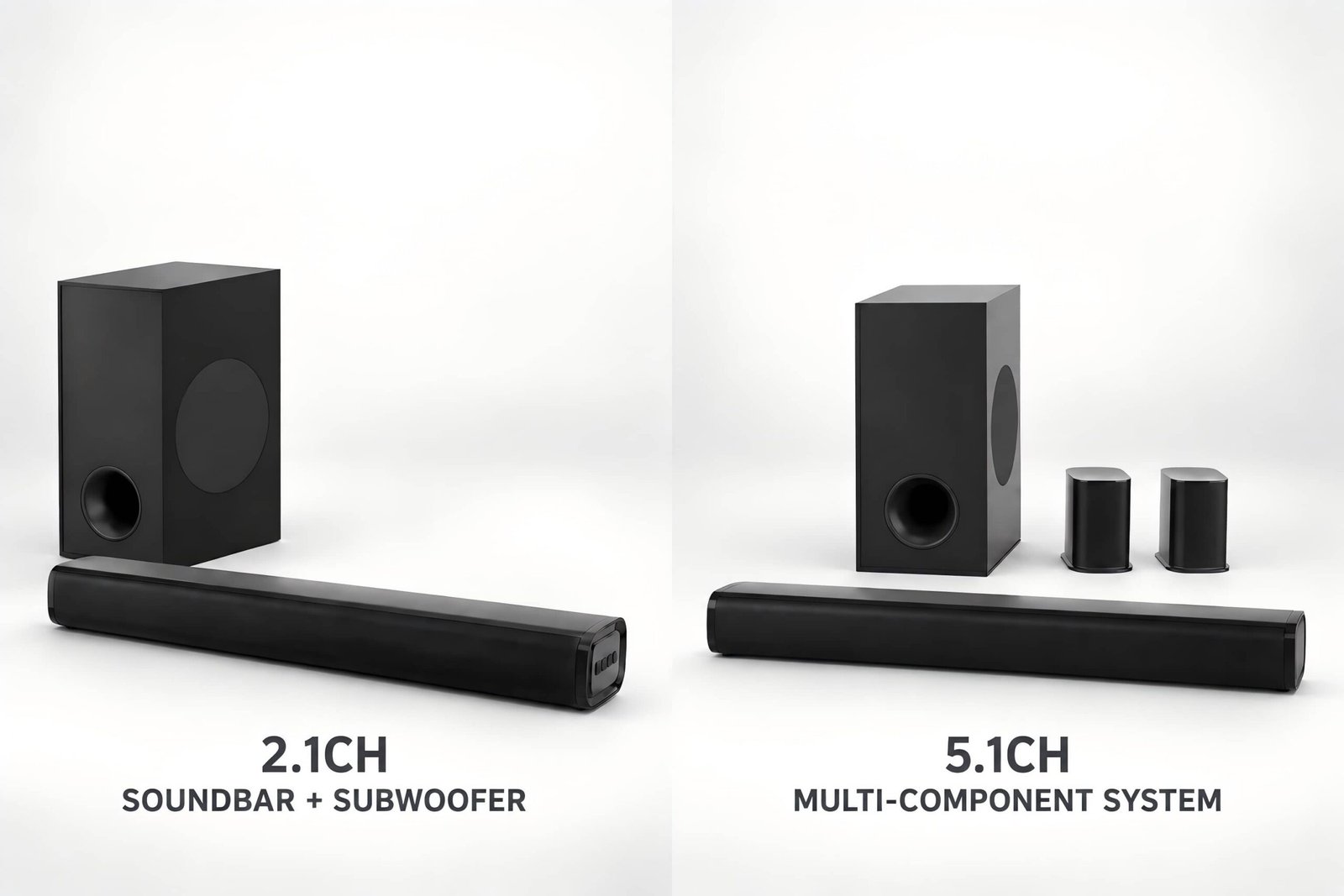
“2.1CH” and “5.1CH” are familiar labels, but they do not tell a B2B buyer everything needed to select a product.
A 2.1CH soundbar may be one visible unit with an integrated low-frequency section, or it may be a bar paired with a separate subwoofer. A 5.1CH offer may use several physical speakers, different connection methods and a more involved setup.
Even within the same channel count, the commercial experience can differ substantially.
For a distributor, retailer or private-label brand, the useful comparison is not simply 2.1 versus 5.1.
It is which complete system better fits the intended user, channel, price position and support model.
What Does 2.1CH Mean in Product Planning?
At a basic architecture level, 2.1CH indicates left and right main channels plus a low-frequency channel.
What matters commercially is how that architecture is implemented.
One product may integrate the low-frequency section into the soundbar body. The visible offer is one unit, which can simplify placement, packaging and product-page explanation.
Another product may use a separate wired or wireless subwoofer. That makes the system architecture more visible and creates a different setup, carton and merchandising requirement.
Neither is automatically better.
They solve different product and channel problems.
The buyer should confirm:
- whether the subwoofer is integrated or separate
- whether a separate subwoofer is wired or wireless
- the number of power connections required
- the physical footprint of every component
- the included cables and accessories
- how the complete system is packed and demonstrated
These details influence the actual customer experience more directly than the “2.1” label by itself.
What Changes With a 5.1CH System?
A 5.1CH architecture generally adds more discrete speaker positions around the listening area.
From a product-planning perspective, that introduces more than additional channels.
It can also introduce:
- more physical components
- more placement decisions
- additional power or speaker-cable requirements
- a larger packaging system
- a longer setup explanation
- more opportunities for incorrect installation
- a greater after-sales support burden
For some channels, that added system visibility can support a clear step-up proposition.
For others, it may create complexity that the sales team, retail environment or end user is not prepared to manage.
A B2B buyer therefore needs to assess whether the channel can explain, display and support the complete system—not only whether the carton can carry a 5.1CH label.
Compare the Intended Setup
The target setup is one of the strongest decision filters.
If the product is intended for a simple television upgrade in a smaller living space, a compact 2.1 system may provide a clearer role.
If the target user expects a multi-speaker layout and is willing to position additional components, a 5.1 system may fit the intended experience.
The room should not be treated as a generic background. Its practical constraints matter:
- Where can a subwoofer be placed?
- Are rear or satellite speakers realistic in the intended setup?
- Can cables be routed safely and neatly?
- Will the user accept multiple power points?
- Does the channel provide installation support?
These questions should be answered before the feature comparison begins.
Consider How the Channel Sells the System
The same product can be easy to understand in one channel and difficult in another.
In a specialist store, staff may be able to demonstrate a multi-component system and explain placement.
In general retail, the display may show only the main bar while the rest of the system remains inside the carton.
Online, the listing must make every included component and connection relationship visible.
This affects content requirements.
A 5.1CH product page may need a system-layout image, carton contents, cable map and placement guidance.
A one-bar 2.1 product may need a clear explanation of how the low-frequency architecture is integrated without implying an unverified performance result.
The product should be selected with the channel’s explanation capacity in mind.
Packaging and Logistics Belong in the Comparison
System architecture changes packaging directly.
A 2.1CH product with a separate subwoofer or a 5.1CH system introduces more components to protect, count and pack than a one-bar 2.1CH product.
Buyers should confirm the carton configuration, total shipped size and weight, protection for each component, and whether all required cables and accessories can be controlled reliably.
These are practical consequences of the architecture—not proof that one format is commercially better.
For the broader framework covering assortment roles, logistics and range commitment, see How to Choose a Soundbar for Distribution and Retail Markets.
Do Not Infer Performance From Channel Count
More channels do not automatically prove better sound, better tuning or a better fit for every room.
Performance depends on the complete product:
- driver selection
- enclosure design
- amplification
- signal processing
- tuning
- component integration
- the way the system is installed
Those outcomes require evaluation on the actual sample or production version.
The same evidence rule applies to decoding and branded audio technologies.
A feature name or source-file reference is not a substitute for current authorization, certification or product-level evidence.
For sourcing decisions, separate three questions:
- What architecture does the product use?
- What user and channel role is it intended to serve?
- What performance and compliance evidence has been verified for this exact version?
This prevents architecture labels from becoming unsupported performance claims.
Decide What the Range Needs
Many buyers do not need to choose one format for the entire business.
They need to decide whether each format has a clear place in the assortment.
A 2.1 system may serve as the main volume product where setup simplicity and a clear television-audio role matter.
A 5.1 system may serve a narrower step-up segment where the channel can explain and support a multi-component setup.
The step-up should be visible in the product role, not only in the number printed on the box.
Before selecting either system, write a short role statement:
This product is for [intended user and setup], sold through [channel], because it provides [one clear system value], with [required setup and support].
If the role statement is vague, the specification comparison is probably starting too early.
FAQ
Is 5.1CH Always Better Than 2.1CH?
No.
Channel count describes part of the system architecture, not universal quality or suitability.
The right choice depends on the intended setup, channel, price position and verified product performance.
Does Every 2.1CH Soundbar Include a Separate Subwoofer?
No.
Some products integrate the low-frequency section into the bar; others include a separate subwoofer.
Confirm the physical architecture and included components.
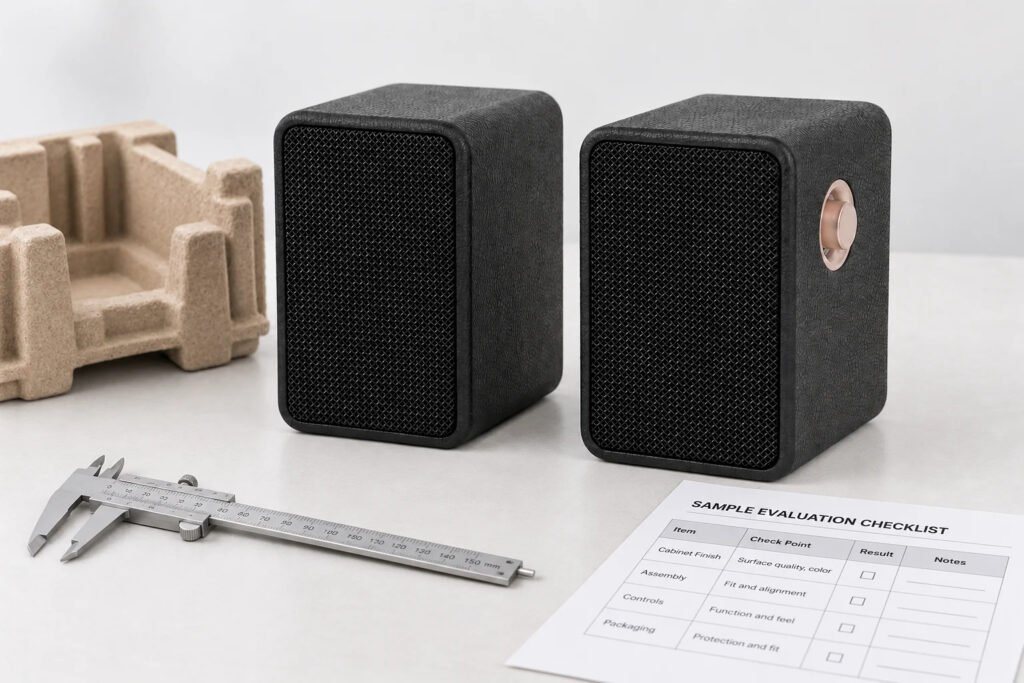
What Should a Buyer Test on a Multi-Component Soundbar Sample?
Test the complete setup:
- connections
- source switching
- channel operation
- component pairing where applicable
- accessories
- cable lengths
- control flow
- packaging
- the intended acoustic target
The exact plan should match the product claim and destination market.
Which System Is Easier to Sell Online?
That depends on how clearly the listing can show the product role, all included components and the setup.
A simpler system may require less explanation, while a more complex system can still work when the channel provides strong visual and support content.
If your range needs a clear 2.1CH or 5.1CH role, ARVICKA Sound can help review the complete system architecture, channel requirements and product-level evidence before the configuration is finalized.