A Bluetooth speaker can look easy to source until two suppliers quote similar products with different wattage, battery claims, IP ratings and feature lists.
The numbers may look comparable.
The products often are not.
One may be designed for compact personal listening. Another may be a larger carryable product for social use. A third may depend on a waterproof story, detachable speakers or several placement states. Even when the catalogue images look similar, the products can create very different questions about sound, runtime, carrying, controls, packaging and after-sales support.
Before comparing price, the buyer needs to understand what each product is actually designed to do, which claims are verified and what still needs to be tested on the exact version.
That changes the sourcing discussion. Wattage, battery capacity and Bluetooth version remain useful, but only when they support a clear product role and an evidence plan.
Start With the Product Role, Not the Numbers
“Portable Bluetooth speaker” is a category label, not a complete product brief.
The useful starting point is the intended situation: who will use the speaker, where it will be carried or placed, which source devices will connect, how it will be sold and what role it should play within the buyer’s range.
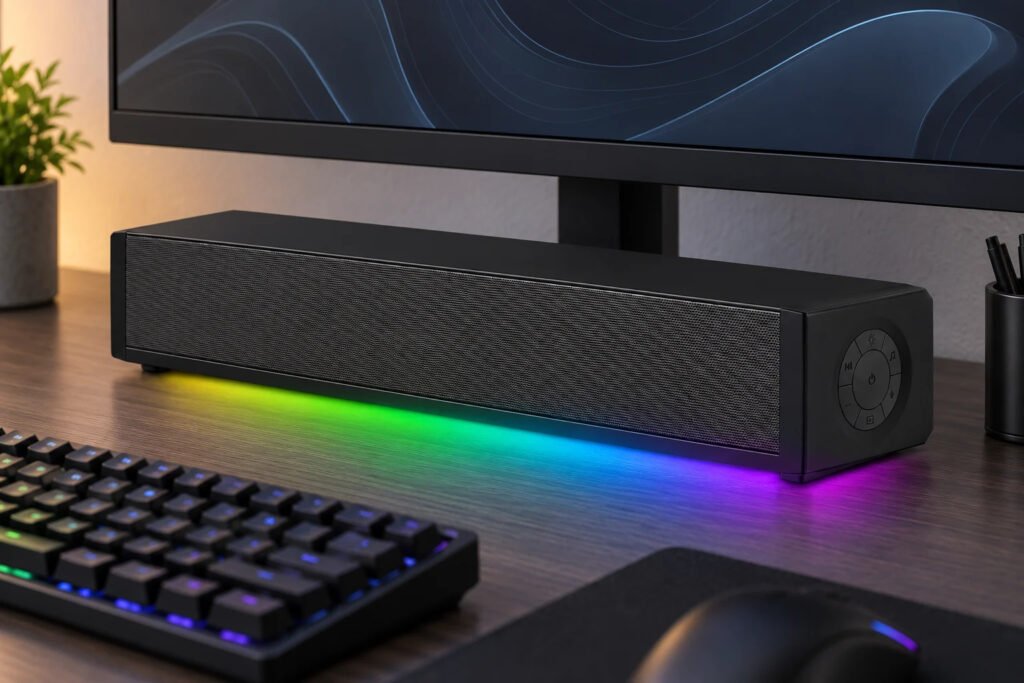
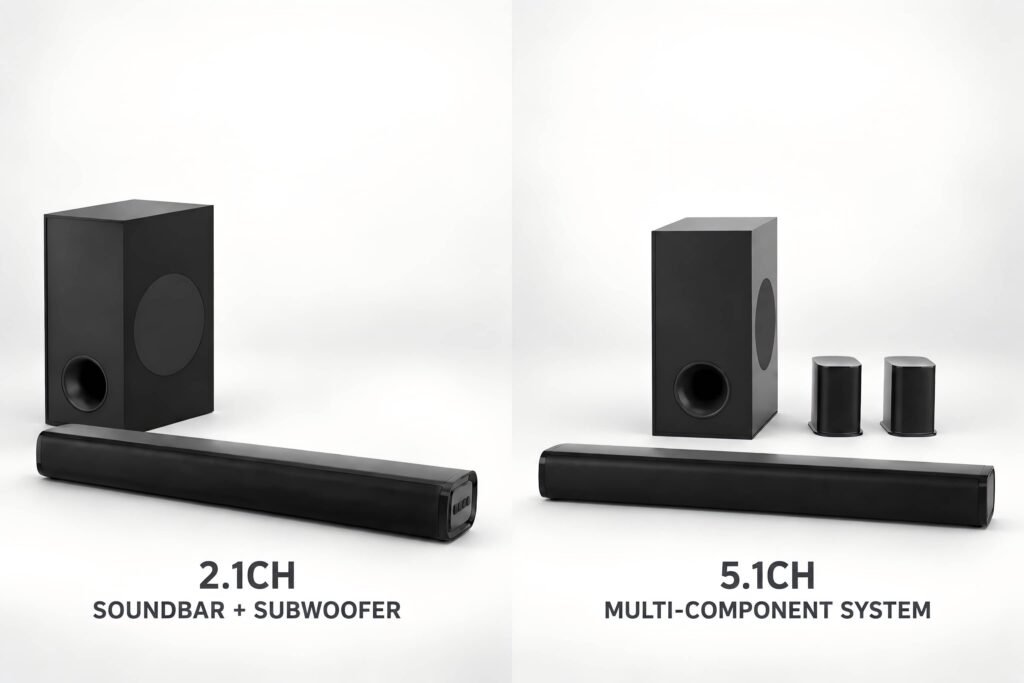
A compact personal speaker, a waterproof outdoor product, a larger carryable system and a detachable multi-part product may all use Bluetooth. Their physical architecture, controls, batteries, accessories and retail explanations should not be treated as interchangeable.
The output number also needs context. Power figures may be stated as RMS, peak or another rating, and may refer to the full system or individual drivers. Supply voltage, distortion condition and battery state can affect what the number means.
A confirmed wattage still does not prove sound quality, coverage or bass performance; those outcomes depend on the complete acoustic and electronic system.
Connectivity should follow the same product-role logic.
AUX, USB playback, charging outputs or other inputs may support a real source or channel requirement. They can also add control, manual, testing and support complexity.
A port should exist because the intended setup needs it—not because a longer feature list looks more competitive.
When the role is clear, specifications become easier to compare because both suppliers are being asked to solve the same problem.
Validate Battery, Wireless and Environmental Claims
Battery capacity does not prove playtime.
Runtime changes with volume, content, lighting, connected functions, battery condition, tuning, temperature and the start-and-end criteria used in the test.
A usable public claim therefore needs a documented method for the exact product version. Where runtime matters commercially, the team may also need repeat testing across more than one unit rather than relying on a single demonstration.
Bluetooth version has a similar limitation.
It identifies part of the technical platform, but it does not describe the complete behavior a user will experience.
Pairing, reconnection, source switching, remembered devices, operating range, audio-video synchronization, multi-speaker functions, firmware behavior, voice prompts and volume handling must be reviewed where they matter to the product role.
Named technologies also need precise boundaries.
If a product supports Auracast or another broadcast function, supported behavior should be separated from qualification or certification status.
Public wording should follow the evidence available for that exact version.
An IP rating is another product-level evidence claim.
Confirm the stated rating, tested version, report or evidence source, port-cover condition and the instructions that apply during exposure, charging and drying.
Water or dust resistance does not automatically prove protection from seawater, drops, impact or long-term outdoor use.
The principle is consistent across all three areas: a specification identifies what should be verified; it does not replace verification.
Check How the Product Is Carried, Placed and Used
Portability is not created by adding a handle to a specification sheet.
It is a physical relationship among size, weight, balance, grip, strap or loop construction, control access, connector protection and the way the product rests when it is put down.
The sample should be handled in the way the intended user would handle it.
A larger speaker may be easy to lift but awkward to balance. Exposed controls may be pressed unintentionally. A strap attachment may look suitable in a render but still need physical review on the real sample.
Multiple product states add another layer.
A speaker shown horizontally and upright may occupy space differently, but imagery alone does not prove equal stability or acoustic behavior in both orientations.
Detachable satellite speakers may create a clear visual difference, but the attached state, detached state, wireless relationship and carrying behavior may each require separate checks.
A demonstration is useful evidence only within the condition it shows.
If two magnetic satellites remain attached throughout a defined carrying and handling sequence, that supports a statement about that demonstration.
It does not prove that the connection will never loosen over time, survive a drop or remain secure under every impact condition.
The same discipline applies to controls.
Their location and structure can be shown. Universal ease of use cannot be claimed without suitable usability evidence.
Make Private Label and Sample Purpose Explicit
Private label can extend beyond printing a logo on an existing product.
Depending on the platform and project, the brand discussion may include grille or enclosure artwork, logo method and position, control symbols, startup and shutdown prompts, color or material options, manuals, labels, packaging, accessories and product-page assets.
These changes are not all equivalent.
Some may be supported presentation options. Others may affect tooling, firmware, production, compliance marks, packaging dimensions or the accuracy of existing images.
The supplier should distinguish what the current platform supports from what requires new engineering or verification.
The sample then needs a defined job.
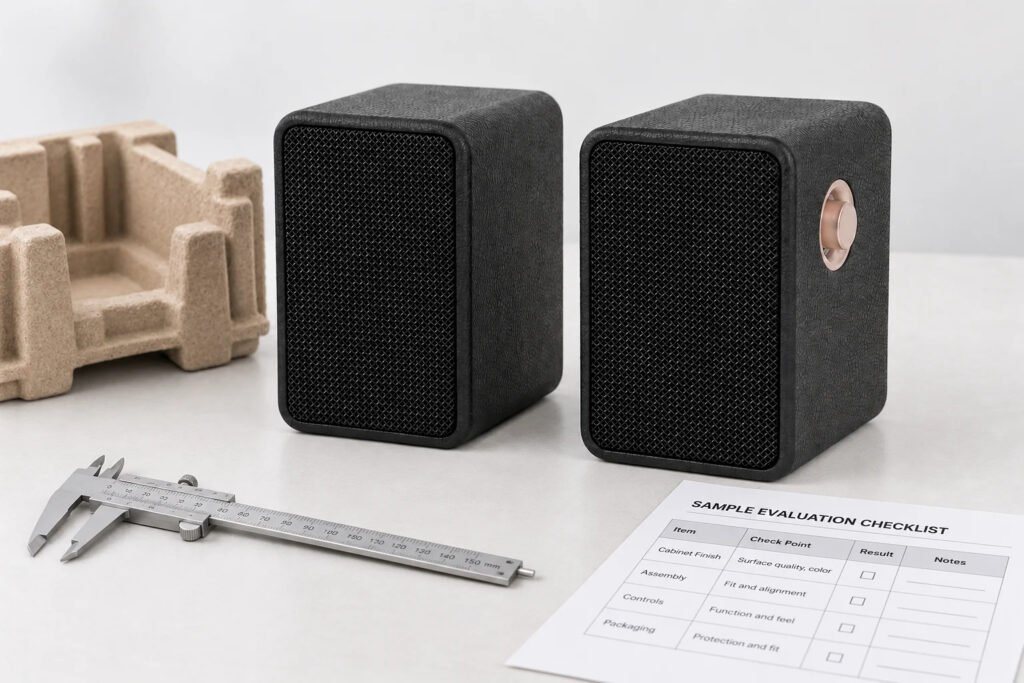
A technical sample may be intended to review sound, wireless behavior or mechanical execution.
A branded sample may support artwork and presentation approval.
A showroom sample may help a team observe which product questions arise in a more realistic retail context.
Those purposes require different levels of finish and different evidence.
Incomplete artwork may be acceptable for an internal engineering review but not for a commercial presentation.
Showroom observation can inform the next product decision, but it is input—not market validation.
Defining the sample purpose before it is built prevents one unit from being asked to prove more than it was prepared to show.
Confirm Packaging, Evidence and Live Commercial Facts
The sourced product is more than the speaker body.
It includes the approved accessories, packaging, claim set and current commercial assumptions attached to the exact version.
Portable speakers may have handles, exposed controls, passive radiators, straps, detachable units or separate charging accessories that need deliberate protection.
The inner tray should support the real product geometry. Accessory compartments should hold the approved contents.
Carton dimensions, weights and master-carton configuration should then feed the loading plan rather than being treated as unrelated logistics data.
Public claims should be reviewed against the same product version.
Output, runtime, wireless behavior, dimensions, weight, materials, environmental ratings and supported functions should each have an appropriate evidence source.
A render, supplier statement or isolated demonstration should not be expanded into a broader performance or durability promise.
Commercial facts need the same version control.
Price, quantity basis, available colors, customization scope, sample timing, production lead-time assumptions, packaging data, compliance evidence and shipment terms are current project facts.
They should be reconfirmed before commitment rather than presented as permanent manufacturer promises.
This is where sourcing becomes commercially coherent: the product being quoted, the sample being reviewed, the claims being published and the package being shipped all refer to the same approved version.
A Short Practical Sourcing Sequence
Use a simple sequence:
Define the role → identify the claims that matter → give the sample a specific job → review the product and packaging evidence → reconfirm the live commercial facts.
This keeps the conversation focused without reducing the project to a long checklist.
It also gives the buyer and manufacturer a clearer way to separate what is already known from what still needs to be tested, confirmed or changed.
FAQ
What Is the Most Important Specification for a Bluetooth Speaker?
There is no single universal specification.
The most important evidence is the evidence that supports the intended product role—such as portability, runtime, wireless behavior, sound target or environmental use.
Can Battery Capacity Predict Playtime?
Not by itself.
Runtime depends on system efficiency, volume, content, lighting, features, temperature and the test method.
Does an IP Rating Make a Speaker Drop-Proof?
No.
Water and dust protection do not prove drop or impact resistance.
Each claim needs its own evidence.
What Should a Distributor Request With a Bluetooth-Speaker Sample?
Request the exact product version, charging accessories, manuals, current specifications, test evidence relevant to the claims, packaging information and a list of known limitations or pending items.
Sourcing a portable Bluetooth speaker for distribution or a new brand line? ARVICKA Sound can help define the product role, select a suitable platform and build the evidence checklist for sample and commercial review.