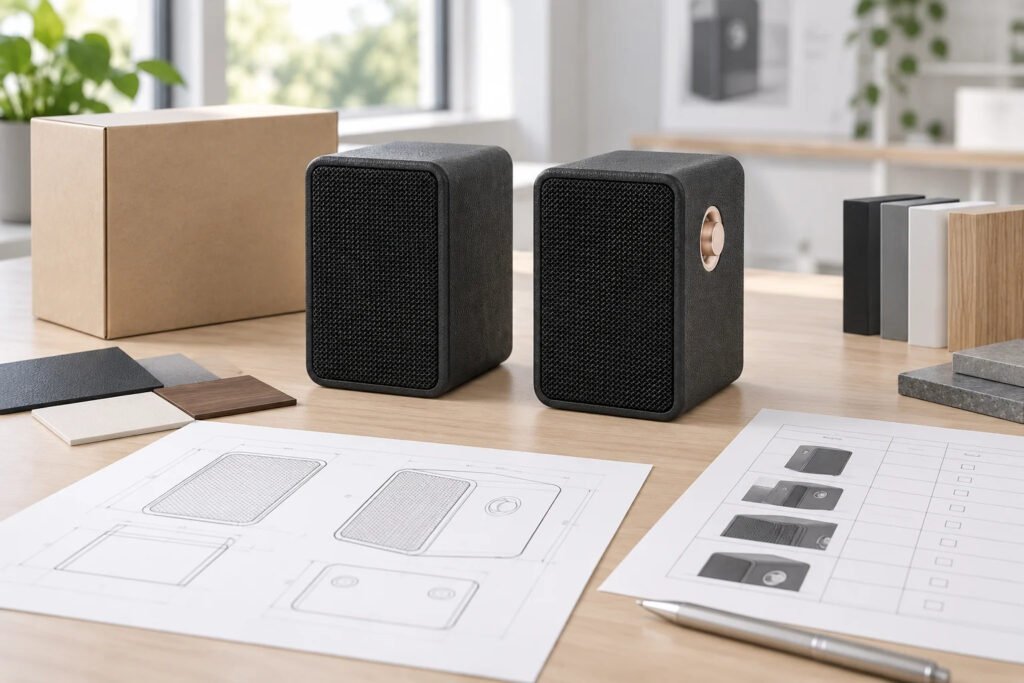
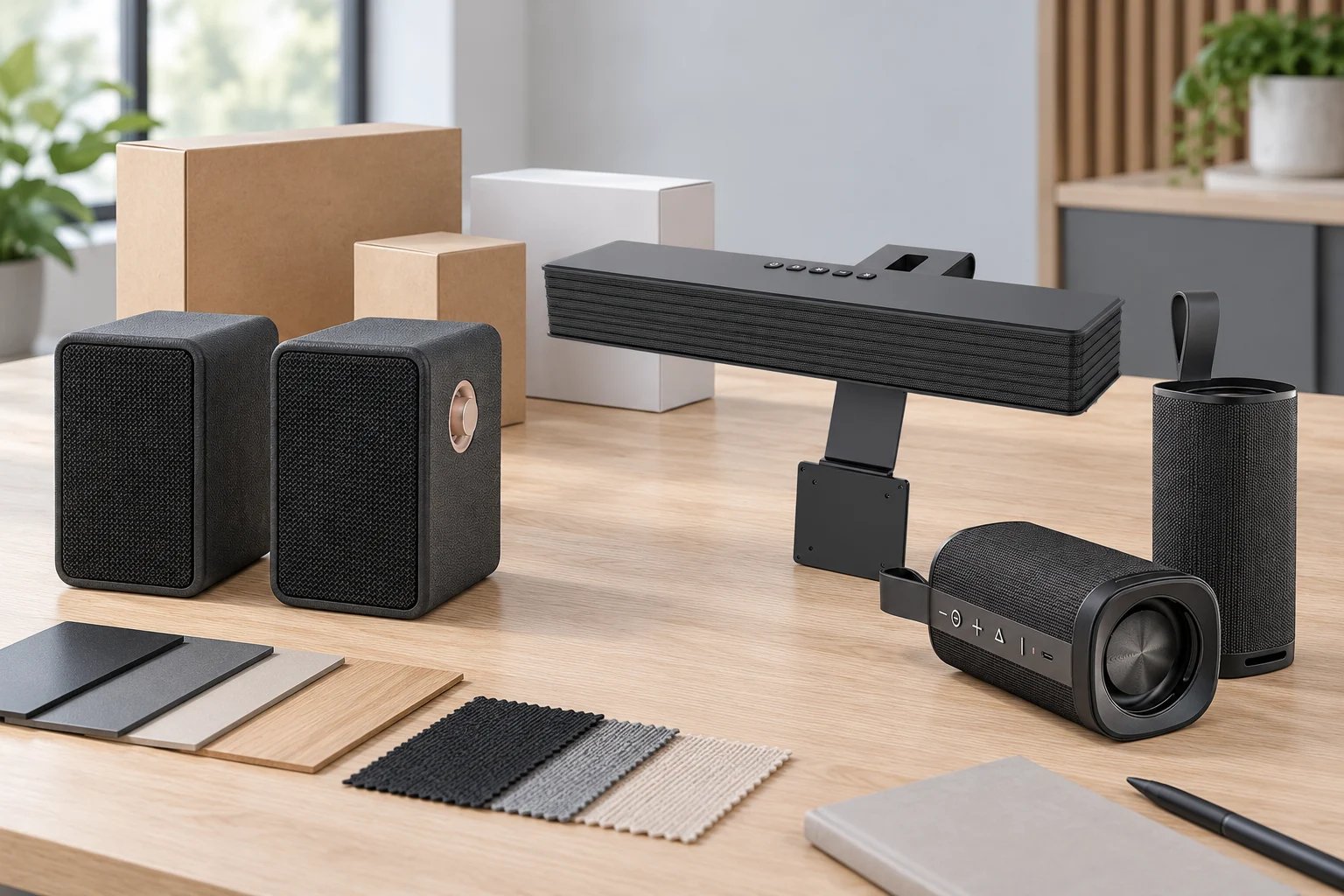
A brand may already know that it wants to start with mature product platforms rather than design every product from zero.
The difficult part is not finding enough existing models. A supplier catalogue can offer dozens of possible speakers, soundbars and portable products within minutes.
The difficult part is deciding which platforms deserve a place in the first range, what should be customized and what still needs to be verified before the launch moves forward.
That is where a mature platform becomes useful. It can reduce some of the starting work, but it should remain a controlled starting point—not a substitute for product and commercial validation.
If the sourcing route itself is still undecided, first read OEM vs ODM vs Private Label Audio: What’s the Difference? This article begins after the private-label route has already been selected.
Start With the Line, Not the Catalogue
Imagine a brand preparing its first private-label audio range. It may be looking at several soundbars, bookshelf speakers and portable speakers that are all technically available.
Availability alone does not explain which products belong together.
The first task is to define the line: who it is for, where it will be sold, which product roles the channel needs and how each item should differ from the next.
A product should enter the range because it has a clear commercial job—not because its appearance is attractive or because it happens to be ready for sampling.
A distributor may need a focused assortment that sales teams can explain quickly. An e-commerce brand may need products whose differences are visible in images and short videos. A retailer may need a clear step-up logic between adjacent offers.
These contexts lead to different selections, even when the supplier catalogue is the same.
Before requesting samples, the project team should be able to describe each proposed product in one sentence:
This product is for [intended user or use case], through [channel], with [one core value], in [its role within the range].
If two candidates cannot be distinguished at that level, adding both may create more operational work without creating a clearer product line.
Treat “Mature” as Something That Still Needs Evidence
The word “mature” can describe different conditions.
It may mean that tooling exists, that samples can be made, that a previous version entered production or that a supplier has experience with the basic architecture.
Those are useful starting signals, but they do not automatically describe the current product version.
For each candidate platform, the buyer still needs to understand what is current and what remains open.
That includes:
- the revision being offered
- available samples
- supported customization
- component status
- quality criteria
- packaging condition
- relevant test or compliance evidence
An existing enclosure may reduce the need for new exterior tooling.
It does not prove that the selected electronics, final branding, packaging or destination-market requirements are already complete.
This distinction protects the project from a common mistake: treating historical platform experience as approval of the final branded product.
Choose Platforms by Product Role
A coherent range is not simply a collection of products with similar styling.
Each platform should solve a different product or channel problem.
One soundbar might be selected for a straightforward television-audio role. Another may belong in the range because its system architecture supports a different setup or retail position. A portable speaker may serve a separate use case entirely.
The relevant comparison is therefore not only between specifications.
It is between product roles.
For each platform, consider how it will be placed, demonstrated, packaged and explained.
Check whether the visible architecture supports the intended product story, whether the required source inputs are present and whether the channel can present the difference without relying on a long feature list.
This is also where category-specific sourcing guidance becomes useful.
A team evaluating active speakers can refer to What to Check Before Sourcing Bookshelf Speakers from a Manufacturer.
For portable products, Bluetooth Speaker Sourcing: Key Questions for Distributors and Brand Owners can help define the questions that belong in the product brief.
The objective is not to choose the largest number of viable platforms.
It is to select a range in which every product has a reason to exist.
Customize Where It Creates Real Brand Value
Once the platforms have clear roles, customization can be judged against those roles.
Logo treatment, colors, control graphics, startup or shutdown prompts, packaging, manuals and selected accessories may all contribute to brand coherence.
Their value depends on the product and the channel—not on the number of changes requested.
A consistent color and graphic system may help several products feel like one range.
Packaging may need to explain the product role more clearly for retail or e-commerce.
A control graphic or prompt may strengthen brand identity when the platform supports it.
By contrast, a change that adds tooling, firmware work or approval complexity without improving the product’s role deserves scrutiny.
The supported scope must be confirmed for each exact platform.
Company-level private-label capability does not mean that every color, graphic, prompt, accessory or firmware change is available on every product.
Customization should make the range more coherent.
It should not turn a controlled private-label project into an undefined development programme.
Validate the Product and the Brand Before Commercial Commitment
A private-label sample has two connected jobs.
First, it must support product review.
The team needs evidence for the agreed functions, physical execution, controls, connections, accessories and any claims intended for sale.
Second, it must support brand review.
Logo treatment, graphics, prompts, packaging, labels, manuals and presentation should reflect the offer the buyer intends to place in front of colleagues, channels or customers.
A technically functional sample with incomplete brand execution may not be ready for a sales meeting or range review.
A visually polished sample does not replace technical validation.
Both sides should therefore agree in advance what the sample is meant to prove and what it is not yet able to prove.
An open issue should remain visible rather than disappear inside a general “sample approved” message.
Before quotation or order commitment, the live commercial facts also need to be reconfirmed.
Product revisions, materials, colors, component availability, customization scope, quantity assumptions, packaging data, lead-time assumptions and compliance status can change.
This is particularly important when the project considers a ready-stock or low-quantity route.
How Ready-Stock Audio Products Can Help Test a New Market explains that use case, but any current inventory, quantity, mixed-model, packaging or shipment promise still requires product-level confirmation.
A mature platform reduces some starting work.
It does not remove the need to make disciplined decisions about the range, the brand execution and the evidence required before commitment.
For a first private-label line, that is the practical advantage: less effort spent recreating a suitable foundation, and more attention available for choosing the right products and completing the work that makes them commercially usable.
FAQ
Can a Private-Label Audio Line Start Without New Tooling?
Often yes, when an existing platform fits the intended product role and the requested changes remain within supported boundaries.
The exact product, tooling status and customization scope still need to be confirmed.
How Many Mature Platforms Should Enter the First Range?
There is no universal number.
Each platform should have a distinct role, and the team must be able to support its samples, artwork, packaging, compliance work, listings and commercial launch.
Which Private-Label Changes Should Be Prioritized First?
Prioritize changes that make the range more coherent or help the channel understand and present the product.
The value of each change should be weighed against its tooling, firmware, approval and evidence requirements.
Does a Mature Product Platform Guarantee a Faster Launch?
No.
It may reduce some development work, but timing still depends on platform selection, customization, samples, materials, compliance, approvals and production capacity.
When Should Commercial Facts Be Reconfirmed?
Reconfirm them before quotation and again before order commitment when necessary.
Current product version, customization, quantities, packaging, lead time, materials and compliance evidence should not be assumed from an older platform record.
If you have already chosen the private-label route and need to turn a group of mature platforms into a coherent first range, ARVICKA Sound can help screen product roles, define a controlled customization scope and plan the evidence needed before commercial commitment.