
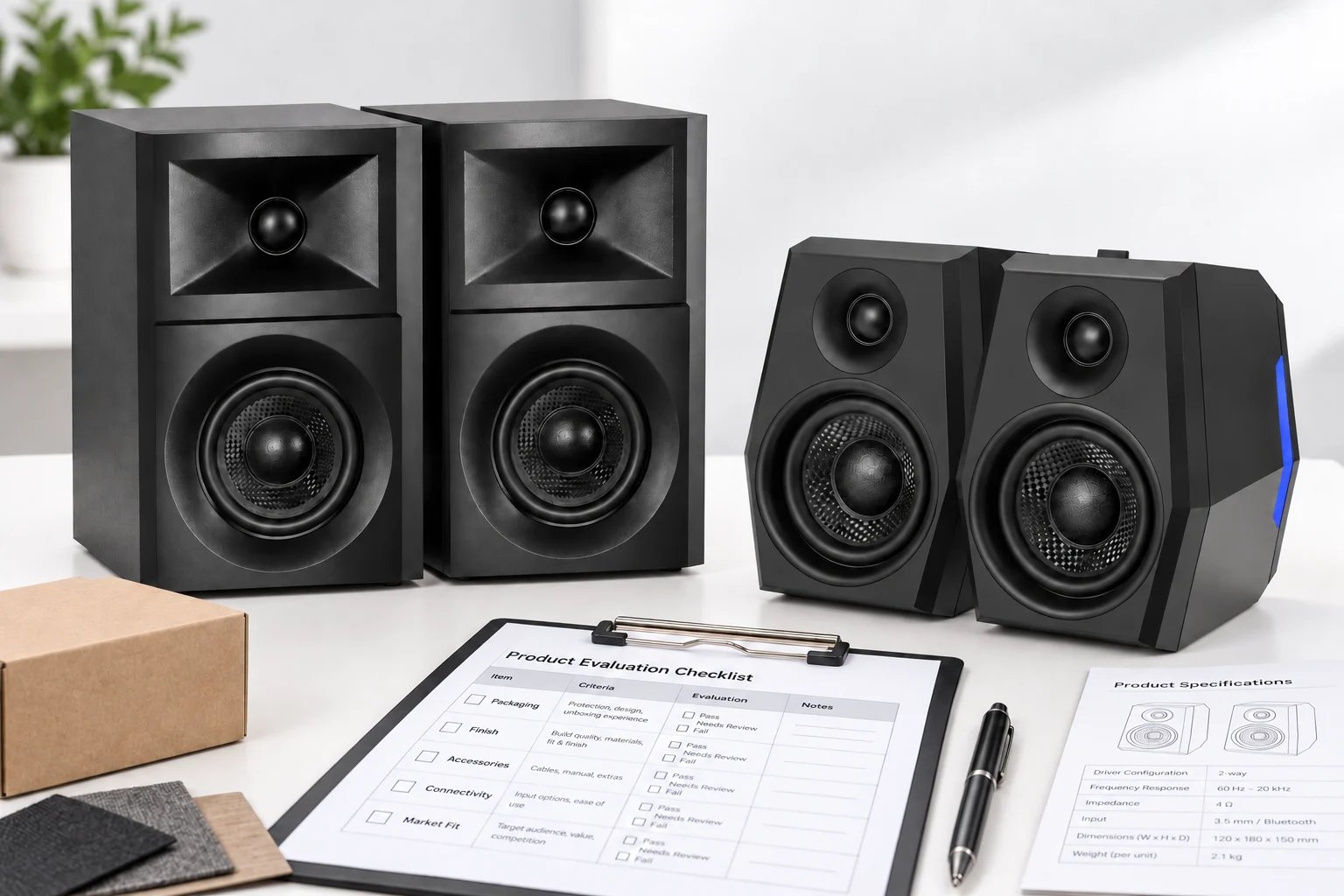
Entering a new market creates a familiar tension.
A distributor or brand wants real feedback before committing to a larger product program, but a full custom development may require more time, evidence and commercial commitment than the first test can justify.
Ready-stock audio products can sometimes provide a practical bridge. They can help a team test a category, price position, channel process or product presentation with an existing product.
But ready stock is useful only when the test has a defined purpose. A small shipment is not automatically market validation, and current stock is not a permanent product strategy.
Start With the Learning Goal
Before asking what is available, decide what the market test needs to learn.
Possible learning goals include:
- Can the channel explain this product category?
- Which product role attracts qualified inquiries?
- Does the price position fit the intended assortment?
- Which product images and messages create useful questions?
- What objections appear during buyer or retailer review?
- Can the local operation handle listing, delivery and after-sales support?
- Which product should receive deeper customization or development?
A test designed around one or two decisions is easier to interpret than a mixed shipment with no clear hypothesis.
What Ready Stock Can Help You Test
When the product, quantity and terms are confirmed, ready stock may help a buyer observe real commercial behavior sooner.
It can support tests such as:
Category Interest
A channel can learn whether customers understand the category and where it belongs in the assortment.
This is more useful than asking whether people “like” the product.
Product-Role Clarity
The team can observe whether the product’s main difference is visible in a product page, short video, sales conversation or retail display.
Price-Position Discussion
The buyer can see what questions arise at an intended retail position.
This does not prove the final price is correct, but it provides input for the next decision.
Operational Readiness
The test can expose local requirements for manuals, plug type, packaging labels, returns, support and delivery.
Product-Selection Priorities
The response may help the buyer decide which category or product role deserves a customized follow-up project.
What Ready Stock Cannot Prove
A limited test should not be interpreted as universal evidence.
It cannot automatically prove:
- long-term market demand
- stable sell-through at scale
- acceptance across every channel or region
- future inventory availability
- permanent price or freight conditions
- the performance of a future customized version
- that a product is suitable for the buyer’s long-term brand architecture
The test reflects a specific product, channel, period, presentation and commercial condition.
The result should be recorded with that context.
Confirm That “Ready Stock” Is Actually Ready
Availability is time-sensitive.
Before planning a test, reconfirm:
- exact model and version
- quantity available
- colors and finishes
- packaging condition
- branding already present on the product or carton
- destination plug and accessories
- current compliance documents
- order and mixed-model rules
- shipment timing
- commercial terms
Do not treat an old stock list, previous offer or general supplier statement as current confirmation.
This is especially important when products come from selected supplier resources rather than a continuously managed core line.
Decide Whether Branding Is Needed for the Test
Not every early market test requires full private-label execution.
An unbranded or existing-brand product may be sufficient for category, setup or operational learning.
A semi-branded sample may be more appropriate when the team needs to evaluate presentation and internal commercial response.
A branded production test may be necessary when brand fit is central to the decision.
The branding level should match the learning goal.
If the product will be shown publicly, confirm that the buyer has the right to use all marks, images and packaging.
If it will be used only for internal or channel review, record that boundary.
Keep the Test Range Focused
A market test becomes harder to read when too many products change at once.
Instead of selecting every available model, consider a small set with distinct roles.
For example:
- one compact entry product
- one step-up product with a visible architecture difference
- one product from a different category only if it answers a separate market question
Avoid several products that differ only by minor specifications.
If the channel cannot explain why each product exists, the test will generate noise rather than learning.
Define the Observation Method Before Launch
Decide what information the team will collect.
Useful signals may include:
- qualified inquiries
- recurring product questions
- retailer or distributor feedback
- reasons for rejection
- content or listing questions
- returns and support issues
- requested features or missing source inputs
- requests for branding or packaging changes
Separate general engagement from buyer evidence.
Views or likes can show attention, but they do not automatically prove product demand or order intent.
Also separate observation from attribution.
If a customer discussion occurs after the test, record what was actually said rather than assuming the product caused the opportunity.
Connect the Test to a Next Decision
A test should end with a decision path.
Possible outcomes include:
- stop the category test
- keep the product as an opportunistic offer
- adjust the product role or price position
- request a better-matched existing platform
- build a private-label version
- commission additional testing or content
- begin a deeper ODM project
The next step should follow the evidence collected, not the desire to justify the original idea.
Ready Stock Is a Tool, Not the Business Identity
For a company whose primary commercial focus is OEM, ODM and private label, ready stock can be a useful secondary capability.
It may help a buyer move quickly when the exact product and terms fit a real opportunity.
It should not be presented as a universal promise of low MOQ, mixed models, immediate shipment or permanent inventory.
The durable value comes from using the test to improve product selection and future development decisions.
A Simple Test Brief
Before requesting availability, write down:
- Market and channel being tested.
- Buyer or user segment.
- Product category and role.
- One or two learning goals.
- Current evidence required before sale.
- Quantity and timing assumptions to reconfirm.
- Branding level.
- Signals to collect.
- Decision that will follow the test.
This turns a stock purchase into a controlled commercial learning activity.
FAQ
Does Ready Stock Mean Immediate Shipment?
Not automatically.
Quantity, version, packaging, commercial terms and shipment timing must be confirmed at the time of the project.
Is Ready Stock the Same as Private Label?
No.
Ready stock describes current product availability.
Private label describes brand and product presentation.
Some stock may support selected branding work, but the scope must be confirmed.
Can a Small Ready-Stock Order Prove Market Demand?
No.
It can provide useful observations in a defined context, but it does not prove long-term or market-wide demand.
When Should a Ready-Stock Test Become a Custom Project?
When the evidence points to a clear product role and the required differentiation, branding, compliance or commercial structure cannot be achieved with the existing product.
If you have a defined market test in mind, ARVICKA Sound can help check whether a currently available product is suitable—or whether an OEM / ODM / Private Label route would create better evidence for the decision.